A safe space for healing and growth.
Therapy and coaching for adults: anxiety, burnout, life transitions, or finding direction. I work with biosynthesis, a conversation that pays attention to the body as well as to words. Sessions are held in Slovak.
Welcome
I'm Mgr. Júlia Pavličová, psychologist and coach.
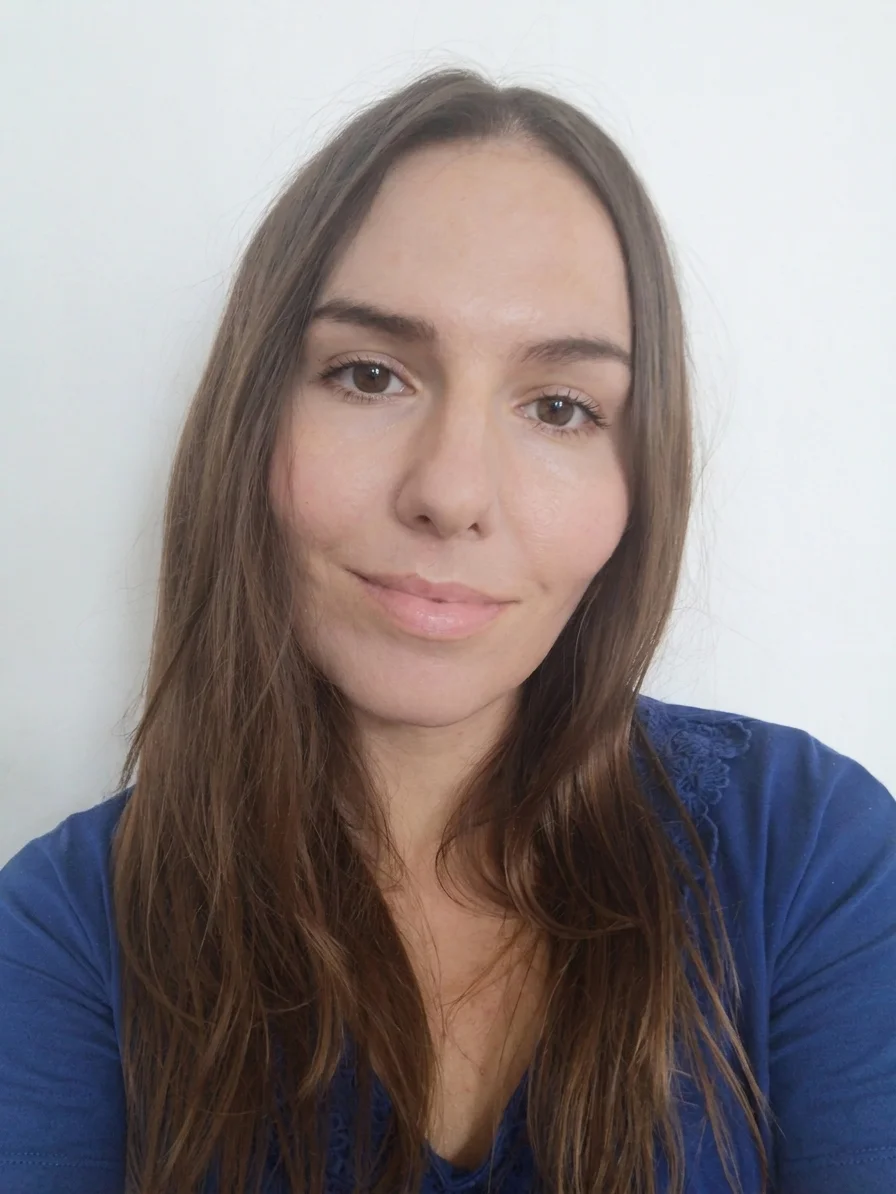
I work with adults moving through a demanding chapter (burnout, anxiety, loss of direction, a relationship or career transition), or simply wanting to know themselves more deeply.
What people most often bring
- Long-standing tension that's now showing up in the body: sleep, breath, digestive trouble, inability to rest.
- Burnout at work or in caring for others.
- Relational difficulties (with a partner, family, or at work): communication, boundaries, repeating patterns.
- Life transitions: a breakup, the loss of someone close, a job change, returning from parental leave, a move, children leaving home.
- A search for meaning and direction, existential questions.
- Integration after a deeper meditative or contemplative experience: retreats, difficulties in practice, the "dark night".
- A wish to know yourself better, with no acute problem, just a sense that it's time.
How we work together
During sessions we sit across from each other in two armchairs. We start with what you bring and choose the next steps together, depending on what the theme and your current capacity can carry. Sometimes a brief turn of attention to breath or to what you sense in your body helps; sometimes staying with words is enough.
You don't need to arrive with a formulated question or a "serious enough" problem. We find the pace together, so you feel safe along the way. If something doesn't resonate or you're not ready for it, we simply don't do it.
About me
I'm 38. I studied psychology, and after graduating I worked for more than seven years in IT corporations for international clients. Working with people under pressure, and my own encounter with burnout, brought me back to what has deeper meaning for me.
I have been practising meditation (vipassana, samatha) for more than ten years. The silence, slowness, and attention to the body that this practice cultivates are a daily support in the therapy room.
I believe most of us live in an "I'm handling it" mode, and that the deepest change comes when we let ourselves stop handling and become present with what we actually feel.
Education and training
Long-form training
- Mgr. in psychology, Faculty of Arts, University of Ss. Cyril and Methodius in Trnava, 2014.
- 5-year training in biosynthesis, Czech Institute of Biosynthesis, 2022 to present.
Supervision. I work under regular individual supervision at the Czech Institute of Biosynthesis.
Further training. Coaching (ICF ACSTH) · Biofeedback and neurofeedback · TRE · Trauma work (SIPE) · Non-violent communication · Mindfulness · Power yoga (Slovak Ministry of Education accreditation).
Full list of further training
| Coaching and constellations | |
|---|---|
| ICF-certified coaching course ACSTH (104 h) | 2020 |
| Relational coaching, ICF (20 h) | 2021 |
| Figure constellations I, II, III | 2023 |
| Biofeedback and neurofeedback | |
| Training course in biofeedback and neurofeedback as a psychotherapeutic method (120 h)ABC Institute for CBT training | 2020/2021 |
| Body, stress, and trauma | |
| TRE method course, a method for releasing tension, stress, and trauma | 2020 |
| TRE method training, first modulefacilitator Deva Laya Guleng | 2023 |
| E-motion, inner child healingDorothe Trassl | 2024 |
| Trauma and dissociation (SIPE) | |
| Understanding trauma and dissociation through neurobiology and attachmentfacilitator Mgr. Hana Vojtová | 2020 |
| Experience, strength, and hope in healing trauma: sharing the wisdom of the 12 steps of AAfacilitator Mgr. Hana Vojtová | 2020 |
| Communication and mindfulness (Plejs) | |
| Mindfulness course | 2016 |
| Non-violent communication course | 2017 |
| Mindfulness in relationships | 2017 |
| Body, movement, and meditation retreats | |
| Taoist yoga, qigong “Eight Pieces of Brocade” | 2018 |
| Power yoga instructor course, Slovak Ministry of Education accreditation | 2019 |
| Intuitive dance, 5 Rhythms | |
| Darkness retreat, 7-day stay in the darkfacilitators Katarína and Roman Miesler | 2022 |
Method. Biosynthesis, an integrative body-oriented approach.
Meditation practice. Vipassana, samatha, over 10 years.
Biosynthesis
A holistic therapeutic approach connecting body, emotions, and mind
Biosynthesis is a holistic therapeutic method that brings a new, integrative approach to therapy. It was founded by British therapist David Boadella in the 1970s. In 1998, biosynthesis was recognised by the European Association for Psychotherapy (EAP) as the first accredited method in the field of integrative psychotherapy.
Unlike purely verbal therapy, biosynthesis sees the person holistically, in the interconnection of body, feelings, and thinking. It is grounded in psychosomatic thinking, which recognises the interplay and mutual mirroring of psychological and bodily processes.
Three life processes
Biosynthesis focuses on connecting three fundamental life processes: movement (body and action), experience (emotions and feelings), and mental (thoughts and cognition). Stress and trauma create blockages on all three levels. Therapy helps release and reintegrate them.
How therapy unfolds
In therapy, alongside conversation, you'll encounter approaches focused on working with breath, movement, imagination, and body awareness. You'll be guided to notice how your physical state affects your thoughts, emotions, and actions, and vice versa. Throughout the process, you stay in control; your perceptions and experiences are always decisive.
Inner resources and self-healing
Biosynthesis trusts your inner resources and natural capacity for self-healing, growth, and balance. The method doesn't focus only on the problem; it also sees your healthy moments, strengths, and possibilities. It helps you reconnect with your own resources and use them to find emotional balance in body, mind, relationships, and life.
Modern scientific foundations
Biosynthesis integrates recent findings from neuroscience (neuroplasticity, polyvagal theory, mindfulness), embryology, and epigenetics. These insights enrich its approach, especially in work with trauma and developmental difficulties.
Who is biosynthesis for?
If biosynthesis speaks to you as an approach, let's set up a consultation and look together at what it could open up for you.
Book a consultation →Services
I work in person in Bratislava (Michalská 20) and online via Zoom. Sessions are held in Slovak.
All sessions last 60 minutes and cost €50, for the initial consultation and for every subsequent session.
Individual therapy
A regular space where you can bring what doesn't get attention at home or at work: anxiety, burnout, relational tension, a life transition, long-standing bodily tension that drains you. We usually meet once a week or once every two weeks.
Book a consultation →Coaching
For situations where you know where you want to go but not quite how. We work with a concrete goal, decision, or transition (a job change, return from parental leave, an important conversation) and lean on the resources you already have. Coaching is not therapy and is not suitable in an acute crisis or for working through trauma.
Book a consultation →For meditators
A space where your practice doesn't need explaining. Integration after retreats, difficulties in practice, "dark night", loss of orientation after a deep experience, questions about the relationship between practice and everyday life. I draw on my own more-than-decade practice of vipassana and samatha.
Book a consultation →Who therapy with me is for
Most people who come to see me are adults recognising themselves in one or more of these situations.
You carry long-standing tension that's now showing up in the body
Sleep isn't deep, breath is shallow, your stomach or head reacts before you can register what you're feeling. Rest doesn't help the way it should. The body signals what the mind hasn't yet had a chance to name.
You feel burned out at work or while caring for others
"I have to handle everything on my own." The energy that used to carry you is gone. You're doing things out of inertia and the appetite for them has faded.
You're going through a life transition
A breakup, the loss of someone close, a new role (parent, manager, solo professional), returning from parental leave, a move, children leaving home, the end of an important chapter. The things you knew no longer apply, and the new ones are still forming.
You're looking for meaning and direction
"Where to next?" "What truly matters to me?" "How do I live so that this life is mine, not borrowed?" Existential questions that planning alone won't answer.
You have your own meditation or contemplative practice
You're looking for someone who understands your practice and can help you integrate it with everyday life.
You want to know yourself better
No acute problem, but a sense that it's time. Therapy as a form of self-understanding, not only as a response to crisis.
The first meeting is for getting to know each other. You tell me what brings you, I tell you how I work, and at the end we decide together whether and how to continue. No commitment to further sessions.
Book a consultation →Frequently asked questions
What people most often ask before a first session.
Do you work in English?
No, sessions themselves are held in Slovak. If your Slovak is limited, please reach out in English first: we'll decide together whether the language is workable for you, and I can refer you to colleagues who work in English if it isn't. Email inquiries in English are welcome.
What is biosynthesis in practice?
Biosynthesis is a somatic, body-oriented form of psychotherapy. Most of the time we talk as in ordinary therapy; the difference is in attention: alongside words, we notice what's happening in the body when you speak about something important. Breath, tension, posture, subtle impulses. The body often knows before the mind does, and for some themes it's the body that opens the way forward. But you don't have to do anything you're not ready for. You always set the pace.
I've never been in therapy. What should I expect?
Nothing is expected of you. You don't need to have a "serious enough" problem, a formulated question, or anything prepared in advance. In our first meeting we'll get acquainted, you'll tell me what brought you here, and together we'll figure out what might help. If something doesn't feel right along the way, we can always slow down, change direction, or stop.
How does the first session work?
The first meeting lasts 60 minutes and serves us both. I'll ask what brings you, about your life situation, and any previous experience with therapy. You'll have space to ask me anything: about the method, about me, about the process. At the end we'll discuss whether and how to continue. There is no obligation to continue if it doesn't feel right.
For whom is therapy with me not suitable?
In line with my current training, I work with adult clients with ordinary life difficulties: anxiety, burnout, relationship and existential crises, finding direction, processing difficult experiences. I currently don't accept clients in acute crisis (active suicidal ideation, acute psychotic episode), with severe addiction or eating disorders, nor children or adolescents. For such situations you need a different kind of specialised help. I'll gladly refer you to colleagues or a specialised facility. For acute crisis, the Nezábudka helpline is available 24/7 and free of charge: 0800 800 566.
How often and how long does therapy last?
A session lasts 60 minutes and we usually meet once a week or once every two weeks. Regularity matters for the therapeutic process: thoughts that ripen in the body between sessions need a regular space to surface.
The overall duration is individual and depends on the topic:
-
8 to 12 sessionsWorking through a specific life changebreakup, loss, job change
-
4 to 9 monthsWorking with long-standing anxiety or burnout
-
12 months or moreDeeper therapy touching themes from childhood or the past
After the first three sessions we always pause to take stock of where we are, what's working, and whether you'd like to continue at the same pace or adjust.
Is everything I tell you confidential?
Yes. Everything we discuss stays between us and is subject to confidentiality.
What if I need to cancel or reschedule?
A session can be cancelled or rescheduled free of charge up to 24 hours before the agreed time: an email or text message is enough. For later cancellations or no-shows the session is payable in full (€50). The reserved slot can no longer be offered to someone else.
I won't charge for a one-off clash. The cancellation policy is here for repeated cases, not for life's surprises.
How much does therapy cost?
A session costs €50. The price is the same for the initial consultation and every subsequent session. Payment by bank transfer or in cash.
Can I claim therapy through my employer or health insurance?
Sessions are provided outside the scope of healthcare (Act No. 576/2004 Coll.), so they are not covered by public health insurance.
If your employer reimburses development activities or offers a wellbeing benefit (Multisport Wellbeing, Benefit Plus, cafeteria, "wellbeing budget"), I can issue an invoice from mindspace s. r. o. that you can submit for reimbursement. Just let me know in the booking form so we can arrange it in advance.
Some commercial health insurers (for example Dôvera in Slovakia) run their own mental-health benefit programmes; it's worth checking with your insurer whether you have access to one.
Book an appointment
Take the first step. Choose a time online, no waiting.
Contact information
Monday & Wednesday, 9:00 – 18:00
811 03 Bratislava
The map is provided by Google. Click to load it; Google may set its own cookies.
Or open in Google Maps.
Public transport: the closest stops are Zochova, Kapucínska, and Hodžovo námestie.
Paid parking: on Zochova or Veterná street, or Garage Center on Uršulínska.
Free parking: the first 3 hours in the Eurovea garages on Pribinova, about a 20-minute walk.
For your first session I'll meet you at the gate. Just send a quick text or call when you arrive.
I offer consultations and therapy relating to mental wellbeing. These are not healthcare services under Slovak Act No. 576/2004 Coll. on healthcare, services related to the provision of healthcare and on amendments and supplements to certain acts.